
The Sovereign Solution to Dealing with the Helpless


There is an undeniable rhythm to the way our world is fracturing. Turn on the news or look out your own back window, and the pattern is unmistakable. Wildfires sweep across timberlands, turning decades of natural growth to ash in an afternoon. Torrential rains hit dry, hardened earth, and within hours, entire towns are swallowed by flooding. We watch rivers breach their banks, power grids buckle under heat, and emergency services stretch past their breaking point.
For many, this escalating chaos feels like a sudden disruption of a stable reality. But for those who study the architecture of human societies—or those who read the deep warnings embedded in biblical prophecy—it is simply the natural consequence of fragile systems pushed beyond their design limits. Fire and flood are ruthless truth-tellers. They strip away the illusion of central security and reveal a simple, uncomfortable fact: top-down institutions are not equipped to protect you when the waters rise or the flames reach the treeline.
Yet, as devastating as these natural events are, the physical destruction of property is only half the crisis. The deeper, quieter tragedy unfolds in the human aftermath. Every fire leaves displaced families in its wake. Every flood creates a new wave of people who have lost everything overnight—their homes, their tools, their livelihoods, and their sense of place. Suddenly, people who were self-sufficient yesterday find themselves standing in lines today, rendered helpless by forces entirely outside their control.
And it is right here, in the smoke and the mud, that a far more dangerous decay becomes visible: the decay of how we look at one another.
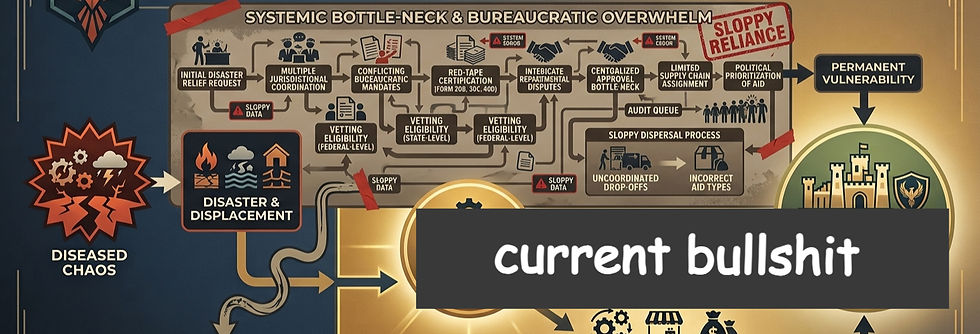
When crisis strikes, our current culture falls into two equally broken reactions toward those who are suffering. On one side is a cold, technocratic detachment that treats the helpless as a administrative nuisance—a set of statistics to be cataloged, managed, and shuffled between temporary shelters and government programs. On the other side is a performative, shallow pity that hands out immediate rations while quietly treating the recipient as permanently broken, stripping them of their agency under the banner of charity.
Neither approach works. Neither approach builds anything that lasts. Both stem from a profound misunderstanding of human dignity and community strength.
If we are going to survive the fires to come and rebuild on ground that will not wash away, we need a complete shift in perspective. We need a framework that rejects both bureaucratic indifference and soft-hearted enabling. We need the Sovereign Solution.
To understand the Sovereign Solution, we must first change how we view the person standing in front of us who has lost everything.

In modern political discourse, the moment someone becomes homeless, destitute, or displaced, they are assigned a new label: needy, helpless, or marginalized. These labels carry a quiet poison. They imply that the person’s defining characteristic is their lack, and that their future depends entirely on external rescue. We look at a man who has lost his home in a wildfire or been cast out by economic collapse, and we see an empty vessel waiting for a handout.
A sovereign perspective demands that we see something entirely different.
A human being is not an administrative burden or a passive recipient of charity. A human being is a creator, a builder, a steward, and an bearer of potential. When a person is rendered helpless by crisis, their core identity has not changed; their structural support has simply collapsed. Their current helplessness is an operational state, not an identity.
When you look at a displaced neighbor through a sovereign lens, you do not see a victim to be pitied. You see a partner whose foundation has been shaken. You see a person who carries latent strength, skills, and energy that must be rehabilitated and re-integrated into the fabric of the community.
Consider how nature operates after a wildfire. The fire is violent, destructive, and uncompromising. It burns away the overgrown canopy, clears the dead wood, and reduces everything to ash. But ash is not useless waste; it is rich in minerals. It fertilizes the soil. It creates the precise conditions required for a healthier, stronger forest to rise from the ground. The fire clears the floor so that real growth can take root.
When disaster strips away a person’s material possessions, it often strips away the superficial noise of modern life as well. It reduces life to its absolute essentials: survival, faith, brotherhood, and purpose. If we meet people in that moment with genuine respect rather than patronizing pity, we can help them channel that reset into a foundation of real, lasting independence.
Pity looks at a helpless person and asks, "How can I make you comfortable in your misery?"
Sovereignty looks at a helpless person and asks, "How do we rebuild your strength so you can stand on your own two feet and help us protect the perimeter?"
This is not just a philosophical nuance; it is a fundamental shift in how we structure our communities.
Look at how our current society handles homelessness and displacement, whether caused by sudden floods or slow economic decay. Millions of dollars are funneled into emergency management agencies, temporary shelters, and endless social services. Yet, walk through the streets of any major city, or visit a region hit by a natural disaster six months after the news cameras have left, and what do you find?
You find permanent dependency. You find people parked in temporary housing that slowly rots into permanent slums. You find an industry built around managing poverty rather than eliminating it.
This happens because centralized systems are designed for control, not transformation. A bureaucratic institution requires a permanent class of clients to justify its own budget and existence. It treats human beings like inventory—sheltering them, feeding them just enough to keep them quiet, and leaving them suspended in a state of perpetual childhood.
This model is failing everywhere, and as environmental and economic turmoil increases, it will collapse entirely.
The Sovereign Solution replaces this broken cycle with a model rooted in craftsmanship, asset creation, and active responsibility. It recognizes that true help does not mean giving a man a permanent bed in a warehouse; it means giving him a hammer, teaching him how to build a timber frame, and putting him to work alongside men who expect greatness from him.
When a crisis creates a pool of displaced, helpless people, a sovereign community does not isolate them in camps. It opens up pathways for them to participate directly in the rebuilding process.
If a flood destroys a riverbank and washes out local housing, the solution is not to wait three months for a federal check that may never cover the real cost. The solution is to mobilize local leadership, organize local labor, and bring every able-bodied person into the field. The man who lost his roof yesterday should be helping raise the trusses for his neighbor’s roof today, and his neighbor should be doing the same for him tomorrow.
By integrating the displaced into the active work of restoration, three crucial things happen simultaneously:
First, physical infrastructure gets built faster, cheaper, and with far higher craftsmanship because it is built by the very people whose lives depend on it. They are not cutting corners to meet a government contract; they are building their own future.
Second, the psychological trauma of helplessness is instantly broken. Nothing cures despair faster than meaningful, physical labor in the company of respected peers. When you give a displaced person a vital role in a hard project, you give them back their honor. You transform them from a burden into a contributor.
Third, the community builds a deep, unbreakable bond of mutual trust. A neighborhood that survives a fire together, clears the debris with their own hands, and raises new timber frames side-by-side is a neighborhood that cannot be easily divided, broken, or bought out. They have forged real sovereignty.
To execute this, we must re-examine the concept of leadership itself.
Most modern leaders are trained for soft times. They know how to manage budgets, navigate corporate hierarchies, write policy papers, and project an image of calm authority when everything is running smoothly. But when the power goes out, the floodwaters cross the main road, and a hundred desperate families show up at the town center looking for guidance, those skills become instantly obsolete.
In times of chaotic transition, managerial leadership collapses. What takes its place is leadership forged through fire.
A sovereign leader is not a manager; he is a master builder and a steady anchor. He understands that leadership is not about maintaining order for its own sake, but about building permanent structures—both physical and cultural—that can withstand the worst storms.
When a sovereign leader encounters the helpless, he does not look down on them, nor does he offer easy platitudes. He leads by example, getting his boots muddy, standing in the cold rain, and demonstrating the discipline required to turn chaos into order. He sets a high bar of personal conduct and demands that those around him rise to meet it.
This requires a radical shift in how we treat the "other"—the outsider, the stranger, the addict, or the victim of circumstance who arrives on our doorstep in the wake of disaster.
The worldly view of the stranger is built on suspicion or naïve acceptance. Suspicion closes the gate and leaves the suffering to die in the cold, weakening the community’s moral heart. Naïve acceptance opens the gate without standards, allowing chaos and destruction to enter and break the community from within.

The sovereign perspective offers a higher road: the open gate with a firm standard.
We welcome the stranger, the displaced, and the helpless, but we welcome them into a culture of work, respect, and mutual accountability. We do not ask where you came from or what mistakes brought you low; we ask what you can build today. We offer you shelter, food, and brotherhood, but in exchange, we demand your effort, your honesty, and your commitment to the collective strength of the perimeter.
If you are willing to pick up a tool, respect the order of the house, and put your shoulder to the wheel, you are no longer an outsider or a helpless victim. You are a fellow builder. You are family.
This approach honors the biblical mandate to care for the poor and the stranger, but it does so without compromising the integrity or safety of the community. It understands that true love is not passive indulgence; it is active elevation.
We are entering a season where the old ways of living will no longer hold up. The climate is shifting, natural volatility is rising, economic systems are showing deep cracks, and the social contract that bound communities together for generations has worn thin.
We can sit back and watch the fires burn, hoping that some distant agency will arrive to save us and care for our vulnerable. Or we can look around at our neighbors, take stock of our land, and begin building the Sovereign Solution right where we stand.
This work starts small, in local pockets, driven by men and women who refuse to accept powerlessness. It starts by mastering local trades, securing local resource networks, and cultivating a mindset of relentless self-reliance. It starts by looking at the homeless man on the corner, or the family displaced by last week's storm, not as a tragedy to mourn, but as a building block for a restored world.
When the fire comes—and it will come—it will burn away everything built on hollow promises, cheap materials, and soft thinking. Let it burn.

Behind the fire, we will be standing on the cleared ground. We will have the tools in our hands, the blueprint in our minds, and our brothers at our side. We will take those who were broken by the storm, lift them up, give them purpose, and together, we will build a sovereign architecture that no flood can wash away and no fire can destroy.


Comments